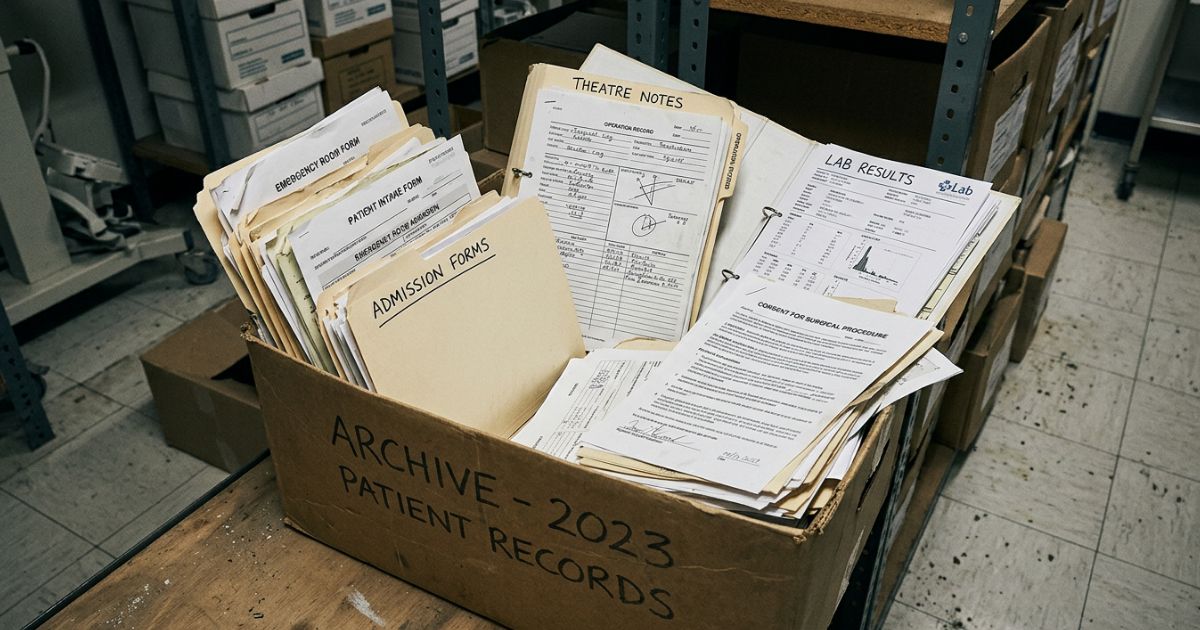
The letter usually comes from an attorney. It asks for a patient’s complete record from an admission some years back: the admission forms, the theatre notes, the lab results and the signed consent. It gives a date.
If the admission was more than a year or two ago, the file may well be in off-site storage, boxed up to free space for patients. So before anyone can answer the letter, someone has to find the file.
From the letter to the file going out
In a hospital that still keeps paper patient files, the steps vary from place to place but the order rarely does.
- The request is logged, and someone checks that it is valid. It may come with the patient’s written consent, as a formal request under the Promotion of Access to Information Act (PAIA), or as a subpoena.
- The records team works out where the file is. That means knowing which facility treated the patient, which admission the letter means, and where files from that period went.
- If the file is off-site, a retrieval request goes to the storage provider and the team waits for the box.
- When the box arrives, someone finds the file and checks that it is complete.
- Anything missing has to be traced. Lab results, referral letters and consent forms are often filed apart from the main folder, or added to it long after the patient went home.
- The record is copied, checked again and released, and the release is noted.
- The original goes back into storage.
Under PAIA, a private hospital has 30 days to decide on a request, and can extend that once, by up to 30 days, in limited circumstances. Subpoenas and court timetables set their own dates, and in every case the clock starts when the letter arrives.
Where the time goes
Copying and releasing the record is the quick part. Most of the elapsed time sits in steps 2 to 5, and four things stretch them out.
Finding the box. Files get boxed by whatever system made sense at the time, whether that was discharge month, ward or surname. If the index lives in a spreadsheet that one person maintains, the search waits for that person.
The file comes back incomplete. The consent form was signed at admission and filed with whatever folder was on the ward clerk’s desk that day. The lab report arrived after discharge and went into a loose-filing tray. Both belong to this patient, and neither is in this box.
More than one facility. A patient treated at two hospitals in a group, or referred between them, may have a file at each. Someone has to ask, and wait for an answer.
Nobody logged who handled it. Once a paper file leaves the box, there’s usually no record of who opened it or what they took out. If the Information Officer asks, the answer is a best guess.
What a missing page costs
When a medico-legal claim is defended, the patient record is the hospital’s evidence. A consent form that can’t be produced weakens that evidence, however good the care was.
There is a privacy question as well. Health information is special personal information under the Protection of Personal Information Act (POPIA), so a hospital should be able to say who handled a patient’s file and why. A file that has been in and out of storage boxes for years makes that hard to do.
Then there’s the running cost: storage and retrieval fees, and the hours your records staff spend searching when there is other records work waiting.
Four questions to ask your records team this month
- How long did our last three medico-legal requests take, from the letter arriving to the record going out?
- How many of them needed a box back from off-site storage?
- Was anything missing when the file arrived, and where did it turn up?
- Could we show who handled each file while it was out of storage?
Where to start
We start hospitals with one department and one process, usually records requests. Patient files are scanned and indexed to the patient number and the admission, consent forms are captured at admission and attached to the file, and every access is logged. The paper original stays with the hospital until the digital copy has been checked and signed off, so nothing is out of reach while the work is done.
Our healthcare page sets out how Metrofile does this for hospital groups and practices.
Or run the four questions with your records team first, and send us what you find.